
Chronic Wounds in Caregiving – What to Watch For
Read time: 12 minute
- Daily caregiver checks (~60 seconds) of the wound bed, drainage, odour, and surrounding skin – plus weekly measurements – are key to prevention, since 26% of Canadian patients have pressure ulcers and 70% are preventable.
- Know the red flags: same-day call for spreading redness, new odour/drainage, or increased pain; urgent care for red streaking, fever, confusion, or visible bone/tendon.
- Avoid common mistakes: no hydrogen peroxide/alcohol/iodine, don’t remove stable eschar (a thick, dark scab-like tissue), don’t apply unprescribed compression, and follow individualized (not fixed) repositioning schedules.
A home care nurse might see your loved one’s wound twice a week. You see it every day. That’s the heart of managing chronic wounds in caregiving – most of what a wound care team learns about a patient’s progress between visits comes directly from you.
That’s not a small thing. Your report of a patient’s progress between visits – your observations, your notes, and the moments that prompt you to pick up the phone – is what a care team needs. You don’t need clinical training to be good at this. You need to know what normal looks like for that wound.
It matters more than most families realize. A national study funded by Wounds Canada found pressure ulcer prevalence of 26% across all Canadian health care settings, with roughly 70% of those wounds considered preventable. Prevention and early detection happen at home, in daily life – which is to say, they happen with you.
Here’s how to build the skill.
What makes a wound “chronic”
A wound is generally considered chronic when it hasn’t meaningfully healed after about four to six weeks, or when it heals and breaks down again in a cycle. (The 4-to-6-week mark is a working convention rather than a strict rule – what matters clinically is whether the wound is trending toward closure.)
The most common ones you’ll encounter at home:
- Pressure injuries (bedsores) — tailbone, hips, heels, ankles, shoulder blades, back of the head
- Diabetic foot ulcers — sole, ball of the foot, or toes
- Venous leg ulcers — lower leg near the ankle, often with swelling and discoloured surrounding skin
- Arterial ulcers — toes or outer ankle, usually painful, with cool or pale skin nearby
- Surgical incisions that reopened or never fully closed
Chronic wounds are rarely isolated issues. They are usually rooted in systemic health factors, such as diabetes, poor circulation, limited mobility, malnutrition, or incontinence, which cause the healing process to stall.
The most powerful steps you can take involve treating the whole body, not just the wound.
Wounds Canada’s Best Practice Recommendations is the Canadian reference standard here, and the 2025 edition is free to read. It has separate chapters for each of the wound types above.
Chronic Wounds in Caregiving: The Daily 60-Second Check
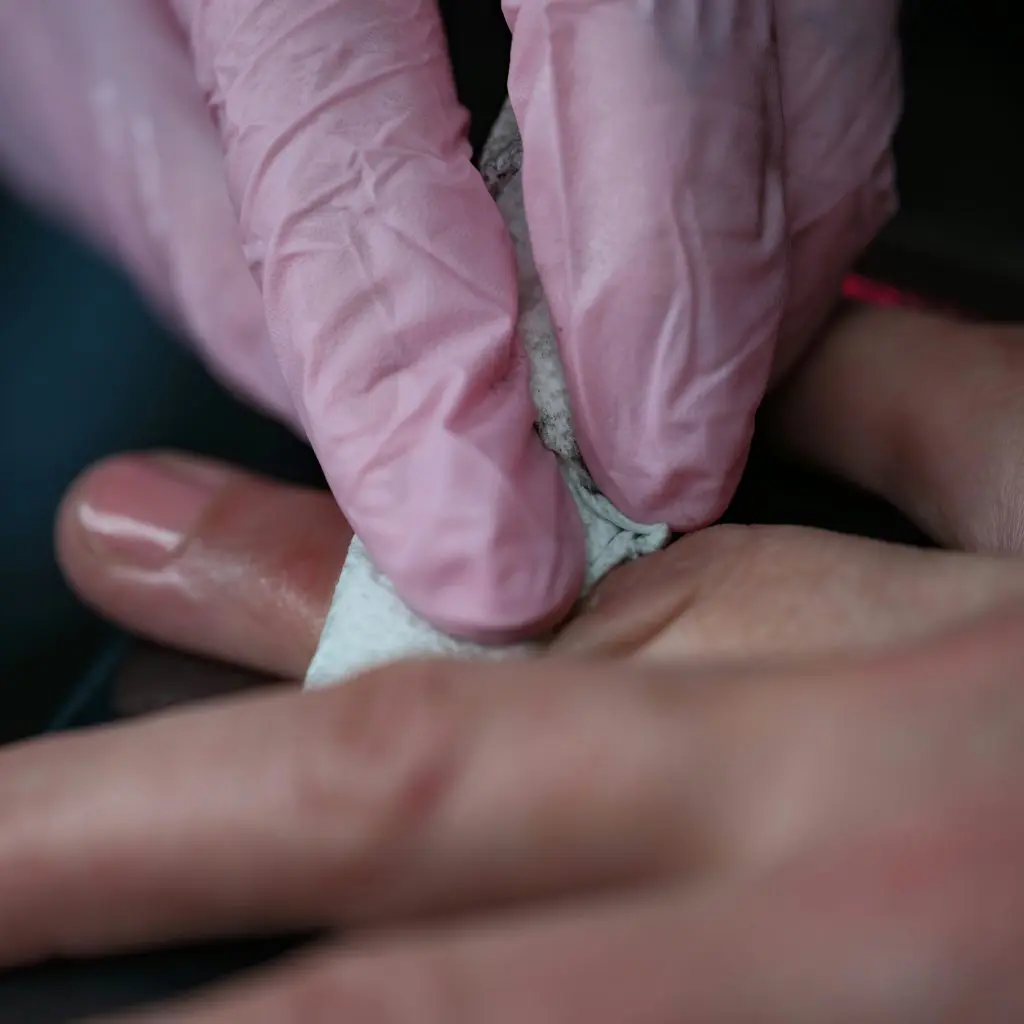
If a nurse changes the dressing and you’ve been told not to remove it, don’t. Your daily check covers everything you can see: the skin around the dressing, the outside of the dressing, and your loved one as a whole person.
- The wound bed (when the dressing is off or the wound is uncovered).
- Healthy healing tissue is pink or beefy red and slightly moist. Yellow, stringy, or filmy tissue is slough. Black or leathery tissue is dead tissue, called eschar – often described as a thick, dark scab-like covering. Watch the shift more than any single colour – moving from mostly pink to mostly yellow over a week is the signal.
- Drainage.
- How much is on the dressing, and what colour? Clear, pale yellow, or faintly pink-tinged is generally expected. Cloudy, thick, green, grey, or a sudden jump in volume is not. Some drainage is normal; a change in drainage is what you report.
- Odour.
- Some dressings have a mild smell on removal that disappears once the wound is cleaned. A new, strong, or foul odour that lingers after cleaning is worth a call.
- The skin around the wound. This is the part people miss, and it tells you the most.
- Watch for redness spreading outward, warmth compared to the same spot on the other limb, swelling, hardness under the skin, or skin gone white and soggy — that’s maceration, a sign the dressing isn’t managing moisture well.
Note: On darker skin tones, early pressure damage and infection often don’t look red at all. NPIAP guidance notes that discolouration appears differently in dark skin tones, and that pain and temperature changes deserve as much attention as colour. Compare to the surrounding skin, and use your hands – feel for warmth, firmness, or a boggy softness.
- Pain.
- A wound that suddenly hurts more than it did, or one that starts hurting when it never did, is a red flag. So is a wound that stops hurting entirely in someone with diabetes — that can mean nerve damage rather than improvement.
The weekly check: measure it
Once a week, measure the wound at its longest point and its widest point, and note it with the date. If you can, photograph it in the same light, from the same distance, with a ruler or a coin beside it for scale.
This single habit changes your conversations with the care team. “It looks about the same” is hard to act on. “It was 3 cm by 2 cm three weeks ago and it’s 4 cm by 3 cm now” is not.
Signs that don’t look like wound signs
In older adults, illness often announces itself somewhere other than the site of the problem. Confusion, falls, and a sudden drop in day-to-day function are recognized “atypical presentations” – delirium in particular is a well-documented atypical manifestation of common illnesses in older adults, alongside falls and functional decline.
Call the care team if you notice:
- New or worsening confusion, agitation, or unusual sleepiness
- Loss of appetite, or refusing fluids
- Blood sugars running higher than usual in someone with diabetes
- A sudden drop in energy or ability – needing help with something they managed fine last week
Don’t write these off as a bad day, or as dementia progressing. Report them.
When to call, and how fast
Call the care team the same day if:
- Redness is spreading outward from the wound
- New odour, or a noticeable increase in drainage
- New or worsening pain
- The wound is getting larger
- The surrounding skin is hard, hot, or newly swollen
Seek urgent care right away if:
- Red streaks running away from the wound
- Fever, chills, or shaking
- Sudden confusion or a sharp change in alertness
- Rapid breathing or racing heart
- Redness expanding over hours
- Bone or tendon visible in the wound
- Blackened tissue appearing rapidly
You will not be wasting anyone’s time. Wound infections in frail adults move quickly, and clinicians would far rather assess a false alarm than a wound that’s been quietly worsening for five days.
What not to do

Well-meant home remedies cause real setbacks.
Don’t use hydrogen peroxide, rubbing alcohol, or undiluted iodine on a healing wound. This one is unambiguous in the literature, including in Wounds Canada’s own publications: these antiseptics are cytotoxic to the tissue of the wound bed and are not recommended as wound cleansers, because they damage the fibroblasts, keratinocytes and white blood cells that do the healing. The bubbling looks like it’s working. It isn’t.
Don’t remove black eschar – hard, dry, dead tissue that looks like a thick, dark scab — especially on heels, unless a clinician has told you to.. NPIAP guidance is that stable eschar (dry, adherent, intact, without redness or fluctuance) on the heel or on a limb with poor circulation should not be softened or removed, because it’s acting as a biological cover. Eschar that is draining or feels boggy is a different situation and does need clinical attention.
Also: don’t pop blisters. Don’t leave a wound uncovered to “air out” unless specifically instructed. Don’t apply creams, ointments, or powders that weren’t prescribed for this wound.
The things that actually move the needle
- Relieve pressure – on a schedule set for your person, not a stopwatch.
The old “turn every two hours” rule has been retired. The 2019 EPUAP/NPIAP/PPPIA international guideline calls for an individualized schedule, because frequency should vary with the person’s pressure injury risk, their ability to reposition themselves safely, their tolerance for current repositioning practice, and the properties of the mattress or cushion in use. Ask the care team what interval they’ve set and why.
The practical test: check the skin every time you reposition. If redness over a bony point isn’t fading within about 30 minutes of pressure coming off, the interval is too long — report it. Float heels off the mattress entirely with a pillow under the calves. Never drag someone across sheets; lift, or use a slide sheet.
- Manage moisture.
Change incontinence products promptly and use a barrier cream on intact skin. Wet skin breaks down in hours.
- Feed the healing.
Wounds are built from protein, and poor appetite is one of the most common reasons a wound stalls. A dietitian referral is available through publicly funded home care in most provinces.
- Check feet daily if your loved one has diabetes – including between the toes and the soles, using a mirror if needed.
Diabetes Canada’s foot care guideline explains why this is non-negotiable: nerve damage and poor circulation mean people with diabetes are less likely to feel an injury, and unnoticed injuries can become infected quickly and lead to serious complications. No bare feet, ever, even indoors.
- Wear the compression – but only what was prescribed.
For venous leg ulcers, compression is the most effective treatment available, and the Cochrane review supports it: people using compression bandages or stockings probably experience complete healing more quickly, and more of them heal fully within 12 months. It’s also uncomfortable, which is why it gets abandoned.
Two hard rules: never apply compression that wasn’t prescribed for this specific wound, and never reuse compression from a previous ulcer or another person. Compression carries higher risk for people with peripheral arterial disease, peripheral neuropathy, heart failure or vasculitic ulcers – and arterial and venous ulcers can look similar to an untrained eye.
The bottom line
Chronic wounds in caregiving can feel overwhelming at first – there’s a lot to watch for, and it’s natural to worry about missing something. But you don’t need to memorize every clinical detail. You need a simple routine: look, note, and call when something changes. Over time, this becomes second nature, and your care team will come to rely on your observations as much as their own clinical assessments. The goal isn’t perfection – it’s consistency.
Keep a simple log: date, size, drainage, odour, pain, and anything that changed. A note on your phone is enough. Bring it to every appointment.
Sources and clinical references
- Wounds Canada — Best Practice Recommendations for Skin Health and Wound Management, 2025 (free; chapters on pressure injuries, diabetic foot complications, venous leg ulcers, arterial ulcers, moisture-associated skin damage)
- National Pressure Injury Advisory Panel — Pressure Injury Stages
- EPUAP / NPIAP / PPPIA — Prevention and Treatment of Pressure Ulcers/Injuries: Clinical Practice Guideline, 2019 (Haesler E, ed.), npiap.com
- Diabetes Canada — Clinical Practice Guidelines, Chapter 32: Foot Care
- Cochrane — Compression bandages or stockings versus no compression for treating venous leg ulcers (2021)
- Nurses Specialized in Wound, Ostomy and Continence Canada (NSWOCC)
This article summarizes published clinical guidance for a general caregiver audience. It is not a substitute for the wound care plan issued by your loved one’s care team. Reviewed by R.N. JR
How often should a family caregiver check a wound?
Daily, for about 60 seconds – checking the wound bed, drainage, odour, and surrounding skin – plus a weekly measurement with photos for tracking.
What are signs a wound is infected?
Spreading redness, new or worsening odour, increased or changed drainage, new/worsening pain, or the wound getting larger – call the care team the same day.
When is a wound an emergency?
Seek urgent care for red streaking, fever or chills, sudden confusion, rapid heart rate, exposed bone/tendon, or rapidly blackening tissue.
Why does wound colour matter differently on darker skin?
Redness and infection are harder to see on darker skin tones – caregivers should compare to surrounding skin and check for warmth, firmness, or swelling instead of relying on colour alone.
What household products should never be used on a wound?
Hydrogen peroxide, rubbing alcohol, and undiluted iodine – these damage healing tissue rather than help it.